Can You Grow Scentsation Honeysuckle as a Ground Cover?
It is late afternoon and you are standing at the top of a bare bank with a new Scentsation in your hand and no trellis anywhere near it. So what does a twining vine do when there is nothing to twine around? It keeps reaching, and the stems that touch soil as they reach are what make this idea work at all.
The species is best planted on structures, but it can be trained as a ground cover. We agree with both halves. Scentsation will cover a bank, but it spreads unevenly and blooms far less than it would on a fence, so plan the planting around that trade.
In this article, we'll go through reading your slope, preparing the soil, spacing the plants, getting through the first weeks, and what flowering looks like once the vine lies down.
Reading the Slope Before Anything Goes In
Walk the bank after a hard rain and watch where the water goes. On a steep face it runs off in sheets and takes fine soil with it, while at the foot it pools and stays wet for days. That is two growing sites in one planting, and a vine set out without noticing them will thrive in one and sulk in the other.
Match the Sun to the Plant
Scentsation grows in full sun or partial shade, so most banks suit it. The species adds a detail that matters on a slope: it prefers its roots in shade with its shoots climbing toward the sun. Laid flat, the stems and the soil are in the same light, so a bare south-facing face that bakes all afternoon is the hardest spot to give it.
On a hot face, plan on a mulch or leaf layer over the roots from day one. It does the job the shade of a fence-base shrub would otherwise do.
Test the Soil You Already Have
Dig a test hole at the top, middle and foot of the bank and squeeze a handful of damp soil from each. If it holds a tight ribbon between thumb and finger, it is high in clay, which has very small pores that hold water and drain slowly. If it crumbles at once, it is sandy, with large pores that drain fast.
Scentsation accepts chalk, clay, loam and sand, so you are not hunting for perfect ground. You are noting which parts of the bank need help draining and which need help holding water. Our soil guide goes further into pH and drainage.
Soil Prep That Drains Without Drying Out
Pick up a handful from the foot of the bank and another from the top, and you can usually feel the problem. Water needs large pores to drain and small pores to be held, and most bank soil has too much of one kind. Compost, which is decomposed organic matter, glues mineral particles into crumbs that hold both sizes of pore. That is how clay learns to drain and sand learns to hold.
The Illinois Extension listing for the species says moist, well drained soil is best, and the cultivar follows the same pattern. Aim for that middle ground, neither dusty nor soggy.
Work in Pockets, Not Across the Whole Bank
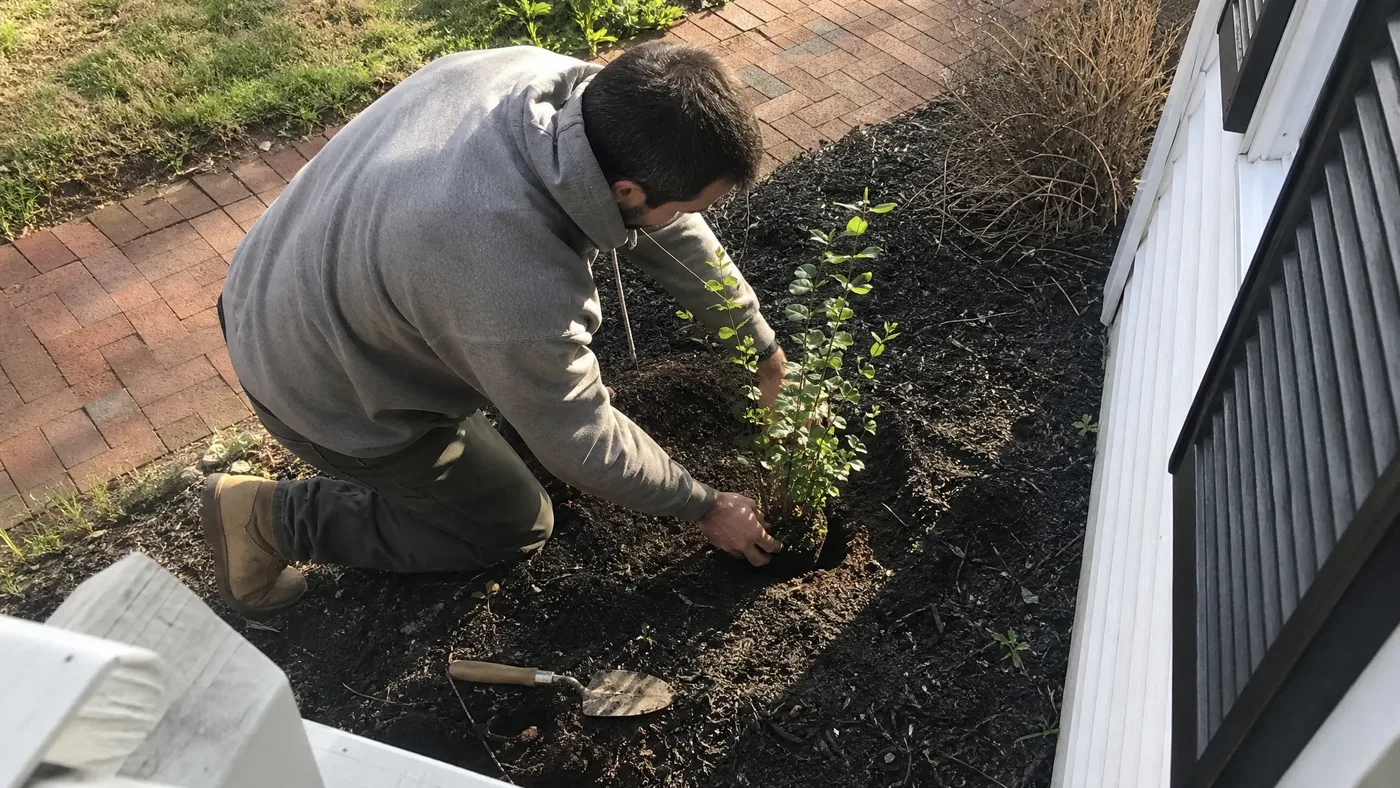
Loosening an entire slope leaves it exposed, and loose soil on a slope is the first to move in a storm. Prepare one pocket per plant instead, using these steps:
- Clear perennial weeds and their roots from a patch about as wide as the plant's spread, because honeysuckle stems will tangle with anything left behind.
- Cut a level shelf into the slope so water soaks in where it lands instead of running past.
- Loosen the pocket and mix in compost, using more in sand and less in heavy clay. The goal is crumb structure, not a rich bed.
- Set the plant at the same depth it grew in its pot, firm the soil gently and leave the shelf slightly dished.
- Mulch the pocket and the ground between plants with shredded leaves or bark, keeping it off the crown.
Resist the urge to swap out the bank's soil for something richer. Roots grow best into ground that continues smoothly from the pocket into the surrounding slope, and a rich pocket in poor soil can behave like a pot that roots hesitate to leave.
Spacing Scentsation Honeysuckle to Close the Gaps
Look at a single Scentsation grown on a fence and you see a narrow plant that is mostly height. The cultivar's listed spread is about 1.6–3.3 feet, but its ultimate height is 13–26 feet. Lying down, that same stem length has nowhere to go but sideways, so a bank planting is decided by how far apart you set the plants, not by how tall they could be.
The species is described by Penn State Extension as a large vine topping out at 10 to 20 feet, and Scentsation is a vigorous climber too. Our guide to how big it gets and how fast covers the vertical habit. On a bank, think in terms of reach along the ground.
Choose a Spacing That Matches Your Patience
We do not have a tested on-the-ground spacing figure for this cultivar as a ground cover, so treat the table as a way to think, and ask your local extension service what has worked on slopes near you.
| Spacing | How the mat fills | Trade-off |
|---|---|---|
| Tight, well inside the listed spread | Stems overlap within a season or two | More plants to buy and more competition for water |
| Moderate, near the listed spread | Gaps close as stems root and thicken | Bare soil shows for the first year |
| Wide, beyond the spread | Slow, patchy and uneven | Weeds and erosion fill the gaps first |
For most banks we lean toward the moderate row, staggered like bricks so no straight gap runs downhill. If you want the quickest cover on a steep face, go tighter. We grow Scentsation ourselves, and a bank is one of the few jobs where we would suggest ordering several plants at once.
The First Weeks Decide Whether Roots Take
Water a new bank planting lightly every evening and the top inch of soil stays wet while everything below it stays dry. The roots then stay shallow, chasing that surface moisture, and the first dry spell hits them hard. Roots follow water, so how you water in the first weeks sets how deep they go.
The species is fairly drought-tolerant once established, and that word "once" carries the weight. Until the roots reach down, the plant relies on you. One of the most common questions we get is why a new bank planting looks stalled, and the answer is usually that it is putting its energy underground first.
Water Slowly, Not Often
On a slope, fast water runs off before it sinks in, which is why the dished shelf matters. Give each plant a slow soak so the pocket fills and drains down, then wait until the soil a finger-length down is only just damp before the next one. Our guide to watering at every growth stage covers the later seasons.
Check the foot of the bank separately from the top. The foot may stay wet long after the crest has dried, and plants at the foot can need far less water than those up high.
Hold Back on Pruning and Fuss
Leave the new stems alone. Each one is a future root source and a place for leaves to feed the roots. If a plant wilts at midday and perks up by evening, that is usually heat, not thirst. Wilting that lasts into the cool of the morning is the signal to water.
How Scentsation Honeysuckle Roots Where Stems Touch Soil
Lift a long stem that has been lying on mulch for a season and you will often find fine white roots at the joints. Those joints are nodes, the points where a pair of leaves attaches, and they can make roots wherever they stay in contact with moist soil. Gardeners call this self-layering, and it is how a few plants become a connected mat.
It is opportunistic, though. Stems root where they happen to touch, not where you would choose, so the bank fills unevenly. A twining vine also wants to climb, and thin, twining stems will heap up on each other and rise rather than spread, unless something holds them down.
Pin Stems Where You Want Roots
Do this once the plants have put on a season of growth, in a mild, damp stretch of the growing season:
- Lay a long stem along the ground, pointing it into the nearest gap.
- Pin it at a node with a bent length of stiff wire, and cover that spot with a handful of loose soil or compost, leaving the leaves and tip uncovered.
- Keep that spot moist until you see new growth beyond it, then check for roots with a gentle tug the following season.
Pin only a few nodes per stem. Rooting at every joint is not needed, and a few well-anchored points hold the bank together just as well.
Steer Climbing Tips Away From Neighbors
Anything upright within reach is a trellis to Scentsation, including young shrubs, small trees and fence posts. Walk the bank every few weeks in summer and turn wandering tips back down the slope. Left alone, they will smother a neighbor, and the honeysuckle will flower happily in its branches while the bank below stays thin.
Flowering on Scentsation Honeysuckle Changes When It Lies Down
On a fence, the best flowers sit at the top of the plant, where the stem tips are actively climbing toward light. That is where our growers see the heaviest bloom, and a vine pressed flat has far fewer of those tips. Expect a bank of Scentsation to flower less than a trained plant. This is a cultivar for fragrance and cover, not a match for a true ground cover bred to bloom along the ground.
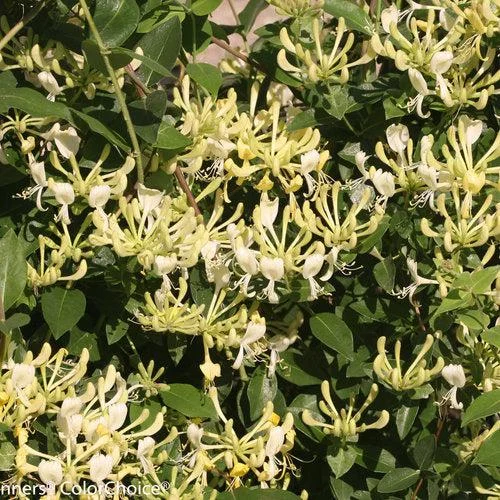
It still flowers, and the scent is the reason to plant it. Mississippi State Extension says Scentsation and Graham Thomas offer good fragrance, and a Master Gardener page from Sonoma County calls it highly scented as its name suggests. The cultivar flowers in summer into autumn, a little later than the species, which blooms in spring and sporadically through summer.
Protect the Old Wood
The plant will flower on old growth, so a hard spring shearing of the whole mat can cost you most of the season's bloom. Tidy edges and cut out stems that are climbing where they should not, and leave the rest. Our pruning guide explains the timing in more detail.
Give a Few Tips Something to Climb
If bloom matters as much as cover, let a handful of leaders rise up a low post or the top of a retaining wall. They will carry flowers where your nose is, and the rest of the mat stays low. If the whole bank stays bare of flowers, our blooming guide covers other causes, such as too little light.
What a Settled Scentsation Honeysuckle Bank Looks Like
By the second or third season, you stop seeing individual plants. The stems overlap in layers, the gaps you pinned across are filled, and the mulch you laid down is half hidden under fallen leaves. Scentsation is deciduous, so in winter you see a tangle of thin stems over a dark carpet of leaf litter, not bare soil.
Maintenance becomes a short walk once or twice a season. Pull the odd weed that has found a gap, cut back stems that have started up a shrub, and pin down any long runner heading off the edge. The bank holds itself.
Why the Bank Stops Washing Away
The real payoff is below the surface. Fine roots from many rooted nodes knit through the top layer of soil, and the leaf litter feeds the organisms that turn it into crumbs. That binding is why a settled bank sheds less soil in a storm than a bare one did, though how much change you see depends on your slope, climate and soil, so judge it by what you see on your own bank.
Bees and other pollinators visit the flowers on warm evenings, and the fragrance carries across the bank when the air is still. That is what you get for the extra care in the early years.
Why a Scentsation Honeysuckle Bank Is Worth the Wait
Scentsation will work as a ground cover if you accept its habits: it spreads unevenly, it roots where stems touch moist soil, and it flowers less when it lies down. Get the soil right, space the plants so the gaps close, water slowly while the roots establish, and pin stems to guide the mat. Leave a few leaders free to climb if you want more blooms.
After three years, dig a handful from the bank. The soil is dark and crumbly, and it holds together in your hand because roots run all through it.
Scentsation Honeysuckle
Nursery-grown Scentsation Honeysuckle in sizes from 2 GALLON, shipped to your door.
From $94.30
Shop Now →Out in our rows, Scentsation sits in soil that stays moist but drains well, with sun for part of the day and shade for the rest, which suits a plant meant to cover ground. Everything we ship was raised by us from start to finish, so what you plant on your bank is stock we know well. If a living carpet of honeysuckle sounds right to you, come and look over what we have when you are ready to plant.