Scentsation Honeysuckle vs Goldflame Honeysuckle: Fragrance and Bloom
The questions we hear most about these two vines come from people who already own one and wonder whether they chose right. Take a breath, because Scentsation and Goldflame are both good vines that simply do different jobs. Scentsation is a woodbine honeysuckle, Lonicera periclymenum, a European native, and that heritage explains most of what it does after sunset.
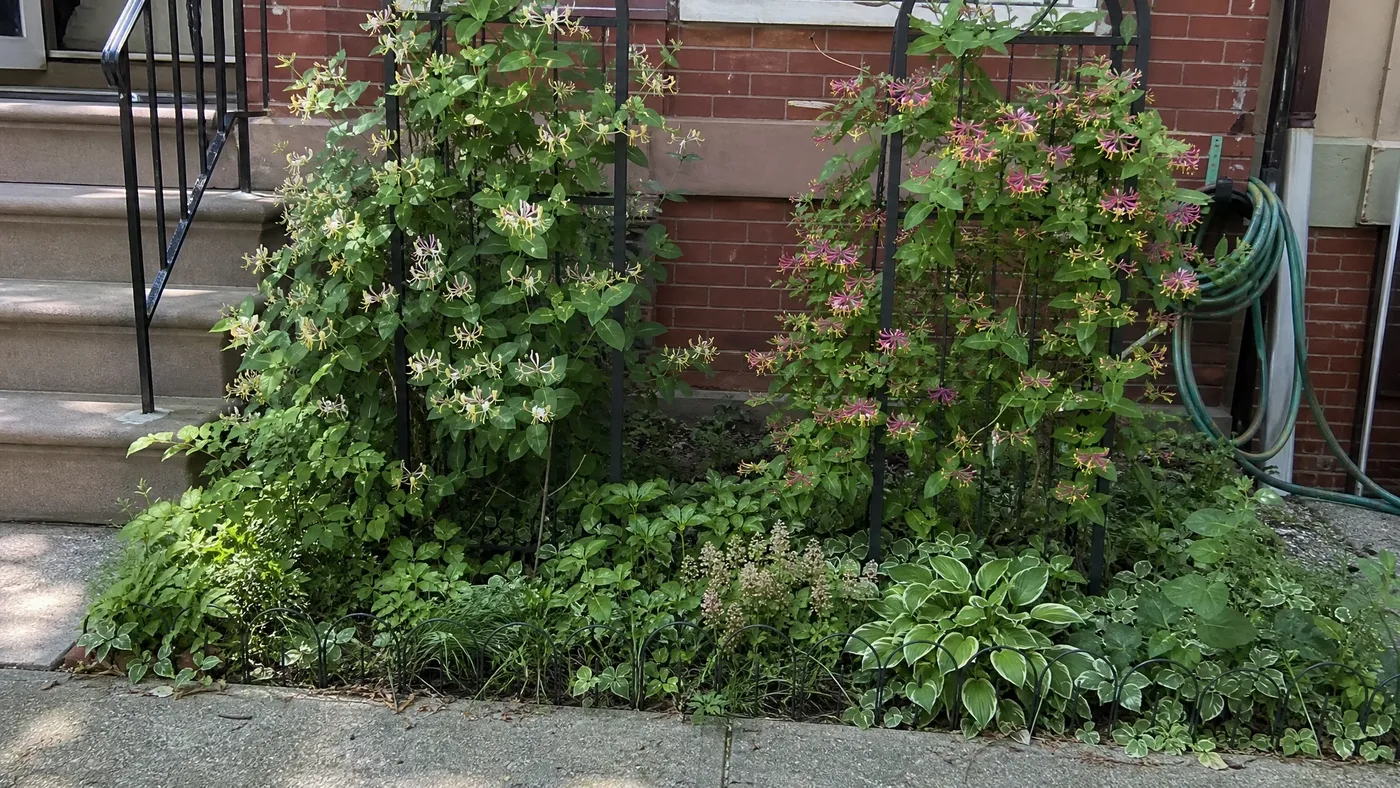
Goldflame is a different hybrid cross, Lonicera x heckrottii, and it plays a gentler, steadier game with pink-and-yellow trumpets that keep opening for months.
This article talks about fragrance, bloom rhythm, color and pruning for both vines and answers the questions customers ask us most. Read on to learn what each one does from morning to night, why Scentsation goes quiet between flushes, and how to settle on one without regret.
What Our Rows Taught Us About Scentsation Honeysuckle
Most owners who write to us describe a vine and ask if it is behaving, so this guide is built from what we have watched on both Scentsation and Goldflame, season after season, rather than from plant tags. Tags tell you a vine is fragrant and floriferous. They rarely tell you when the fragrance peaks, how long a flush lasts, or what a normal quiet week looks like.
Start with size, because it shapes everything else. Scentsation is a vigorous climber that reaches about 13 to 26 feet and stays slim, roughly 1.6 to 3.3 feet across, which is taller and narrower than the species figures of 10 to 20 feet and 3 to 6 feet. Goldflame is smaller, and Illinois Extension gives it 10 to 12 feet while noting that it climbs more weakly than other honeysuckles.
In practice, Scentsation wants a post, pergola or tall trellis it can wind around, while Goldflame is happy on a lower fence and can even be pruned to a 6-foot shrub. Match the vine to the structure before you fall for a flower, because a mismatch shows up in year two, not year one.
Light and soil divide these two less than people expect. Scentsation takes full sun or partial shade and likes moist but well-drained ground, and chalk, clay, loam or sand are all acceptable. Either vine will be fine in an ordinary sunny bed, so the real decision rests on scent, rhythm and color.
Evenings Belong to Scentsation Honeysuckle's Perfume
Walk along the Scentsation rows at dusk and the perfume changes character. It builds as the light fades, and by full dark it is the strongest thing in the air. That matches the species, whose fragrance is more noticeable after dark and attracts moths as its native pollinators, so the timing is part of how the plant is built.
In our rows, a midday sniff and a dusk sniff can seem like two different plants. Extension writers describe the cultivar as highly scented as its name suggests, and the name is earned, but only if you are standing there at the right hour. Customers who test a plant at noon and shrug are judging it at its quietest.
So put the vine where you are in the evening. A patio, a porch rail, or a trellis beside the bench where you sit after dinner all work well, as does a spot under a bedroom window you leave open on warm nights. The far corner of the yard that you only visit at noon is the wrong home for it, because a fragrance that peaks at dusk is wasted on a place you leave before sunset.
Distance matters too. On a still evening the scent pools close to the vine, so a seat within a few steps beats one across the lawn. Expect moths around the flowers once the light goes. That is the plant doing exactly what it evolved to do, and it is half the charm of an evening out there.
Why Goldflame Smells Sweet but Never Heavy
Goldflame's 1.5-inch flowers are pinkish-purple outside and open to show a yellow interior, and NC State describes them as weakly fragrant. Illinois Extension calls them slightly fragrant. We agree with the sweet half of those descriptions. Brush past it and you get a light, pleasant sweetness that is gone again a few feet later.
That lightness is a feature in the right place. You can sit beside a Goldflame all afternoon without the scent crowding your coffee, which suits a small porch, a kitchen window or a spot next to a dining table where a heavy perfume would compete with dinner. Choose it for its color and its long season, and treat the scent as a pleasant extra.
When someone asks us for the most fragrant honeysuckle vine, we point to Scentsation without hesitating. Goldflame earns its place for other reasons, and expecting a drenching perfume from it is the surest route to disappointment. Customers who bought it for scent and feel let down are usually just misreading what it was ever meant to do.
If fragrance is your main reason for reading this, our guide to why Scentsation smells so good goes deeper on the scent itself. For a window you want to open all summer, either vine will do, but only one will perfume the room after dark.
Flushes, Gaps, and the Goldflame That Keeps Going
Scentsation blooms in waves. A heavy flush of cream flowers opens, then thins out, then another push follows. Sources describe the cultivar as flowering from summer into autumn, Wisconsin Extension lists it as blooming late spring to summer, and the species blooms in spring and sporadically through the summer. All of that points to the same pattern of bursts rather than a nonstop show.
Goldflame works differently. It blooms in terminal whorls from spring to fall, which means fresh clusters keep opening at the tips of the stems while older ones fade behind them. There is no dramatic peak and no real gap, just a steady supply of pink-and-yellow trumpets. For a view that looks much the same from week to week, it is the more dependable vine.
The way to set expectations is to judge each vine on its own terms. Judge Scentsation across the whole season, not on one quiet week in midsummer, and judge Goldflame on how consistently it holds color rather than on how much perfume it gives. Most disappointment we hear about comes from holding one vine to the other's standard.
If a Scentsation never flushes at all, that is a separate problem from a gap between flushes. Our guide on why a Scentsation honeysuckle isn't blooming walks through the usual causes, starting with light and pruning.
Colors Change Through the Day on Both Vines
Goldflame is a two-tone flower, pinkish-purple outside with a yellow corolla inside. Tight buds and half-open tubes read mostly pink, while fully open trumpets show the yellow, so the vine looks pinker from across the yard and more golden up close. A single stem can carry both looks at once, which is why photos of it vary so much.
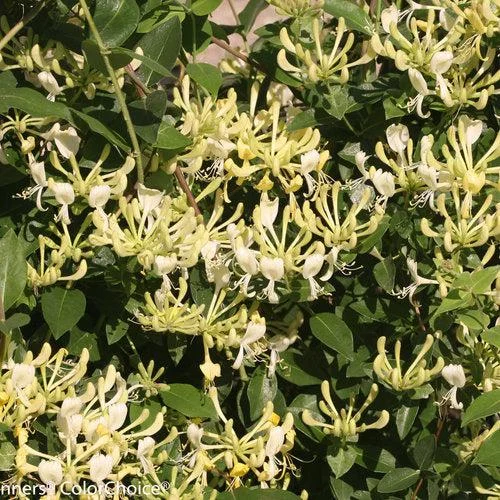
Scentsation's flowers open pale yellow, ivory or white and age to a darker yellow, like those of the species, and the cultivar is creamy-white to yellow. One vine at dusk therefore carries cream and gold flowers side by side. Do not expect the pink and purple tones that show up elsewhere in the woodbine family, because this cultivar stays in the cream and yellow range.
Use that for photos and placement. Cream flowers glow in low evening light and look washed out under hard noon sun, so shoot Scentsation in the last hour of daylight. Goldflame holds up in stronger light, and mid-morning gives its two colors the best contrast.
For placement, pale Scentsation shows best against a dark fence or green wall, where the flowers still read after sundown. Goldflame's warm tones stand out against lighter or neutral backgrounds. Our Scentsation bloom time and flower color guide shows how the cream shifts through a flush.
When Scentsation Honeysuckle Rests Between Flushes
One of the most common questions we get is whether a resting Scentsation is sick. If the leaves are green, the new shoots keep extending and nothing is wilting or spotted, the answer is no. The plant is between waves, and a thinner stretch after a big flush is normal for a woodbine honeysuckle.
The temptation is to do something, and mostly we tell customers to do very little. A short list covers what helps and what harms:
- Keep watering when the top inch or two of soil dries out, since the cultivar likes moist but well-drained ground and a resting vine is not a dormant one.
- Skip the extra fertilizer meant to force flowers, because it usually buys more leaves than blooms.
- Leave the shears in the shed, because the plant flowers on old growth and a rescue haircut removes the wood that would carry the next wave.
- Look under the leaves now and then for honeysuckle aphids or thrips, which are the pests worth checking for, and treat only if you find them.
Most owners find the next flush shows up within a few weeks without any intervention at all. A Scentsation that has rested, then flowers again just as the evenings turn warm, is simply running its normal schedule. Patience is the one maintenance task people are worst at, and it is the one that works.
Trimming Habits That Suit Scentsation Honeysuckle and Goldflame Alike
The same timing works for both vines: trim right after a flush, not in the middle of building one. Keep in mind that the periclymenum species will flower on old growth, so a light cut just after flowers fade removes spent and crossing stems while leaving the wood that will bloom later. A hard cut in late winter does the opposite and removes what you came for.
For Scentsation, that means tipping back wandering shoots, tying in the stems you want, and thinning only what is dead or tangled. The vine is tall and narrow, so the job is mostly guiding it up its support. If it has outgrown its space, remove a few of the oldest stems over a couple of seasons rather than all at once.
Goldflame is more forgiving about size. It can be kept as a 6-foot shrub if you like, and because it carries flowers in whorls at the stem tips, a trim just after a wave of bloom lets the next wave form without a long pause. Check with your local extension service for the best timing in your zone, since climate shifts the calendar.
Whichever vine you prune, resist shearing it into a ball. Both look best with their stems left loose and trained along the support. Cuttings from a trim also make lovely indoor sprigs, and our guide on cutting Scentsation honeysuckle for flower arrangements shows how to bring that dusk scent inside.
Choosing Between Them Without Second-Guessing
Here is how we settle it for customers. If your best hours outdoors come after sunset, or if fragrance is the reason you want a honeysuckle at all, choose Scentsation. If you want pink-and-yellow color from spring to fall with a lighter scent, choose Goldflame. Our own pick for the fragrance question is Scentsation, and we would not hedge on that.
The table below lines up the traits that decide it.
| Trait | Scentsation | Goldflame |
|---|---|---|
| Scent | Highly scented, strongest after dark | Weakly to slightly fragrant |
| Bloom pattern | Waves with quiet stretches between | Whorls from spring to fall |
| Flowers | Creamy white aging to yellow | Pinkish-purple outside, yellow inside |
| Size | About 13–26 feet tall, 1.6–3.3 feet wide | About 10–13 feet, prunable to 6 feet |
| Hardiness | Species zones 5–9 | Zones 5–8 |
Some people want a non-invasive vine. Mississippi State Extension says the Scentsation selection is native to Europe but does not appear on any invasive species list. Goldflame is listed as invasive in Illinois and has not been reported as invasive elsewhere, so check your own state.
If you cannot choose, plant both. Put Scentsation by the evening seat and Goldflame along the path you walk every day, and our landscape ideas for Scentsation honeysuckle vines and fences show how to give each a support of its own. Scentsation is the vine we grow ourselves, so it is the one we can describe with confidence.
Send Us a Photo of Your Scentsation Honeysuckle
Scentsation is the evening vine, with a dusk perfume that arrives in waves and rests between them. Goldflame is the daytime vine, with steady pink-and-yellow color and a lighter sweetness. Prune both just after a flush, give both a support that fits their size, and judge each by its own strengths.
If you own one and are still wondering whether it is doing the right thing, call or write to our customer desk with a photo of the vine. We will give you an honest answer, even if the answer is that you simply need to wait for the next flush.
Scentsation Honeysuckle
Nursery-grown Scentsation Honeysuckle in sizes from 2 GALLON, shipped to your door.
From $94.30
Shop Now →Scentsation does its best on our farms in ground that holds moisture yet drains freely, with full sun to partial shade overhead. Growing and selling top-quality plants from those farms lets us stand behind the dusk fragrance this guide describes. If that evening perfume is what you want in your garden, begin with a Scentsation of ours.