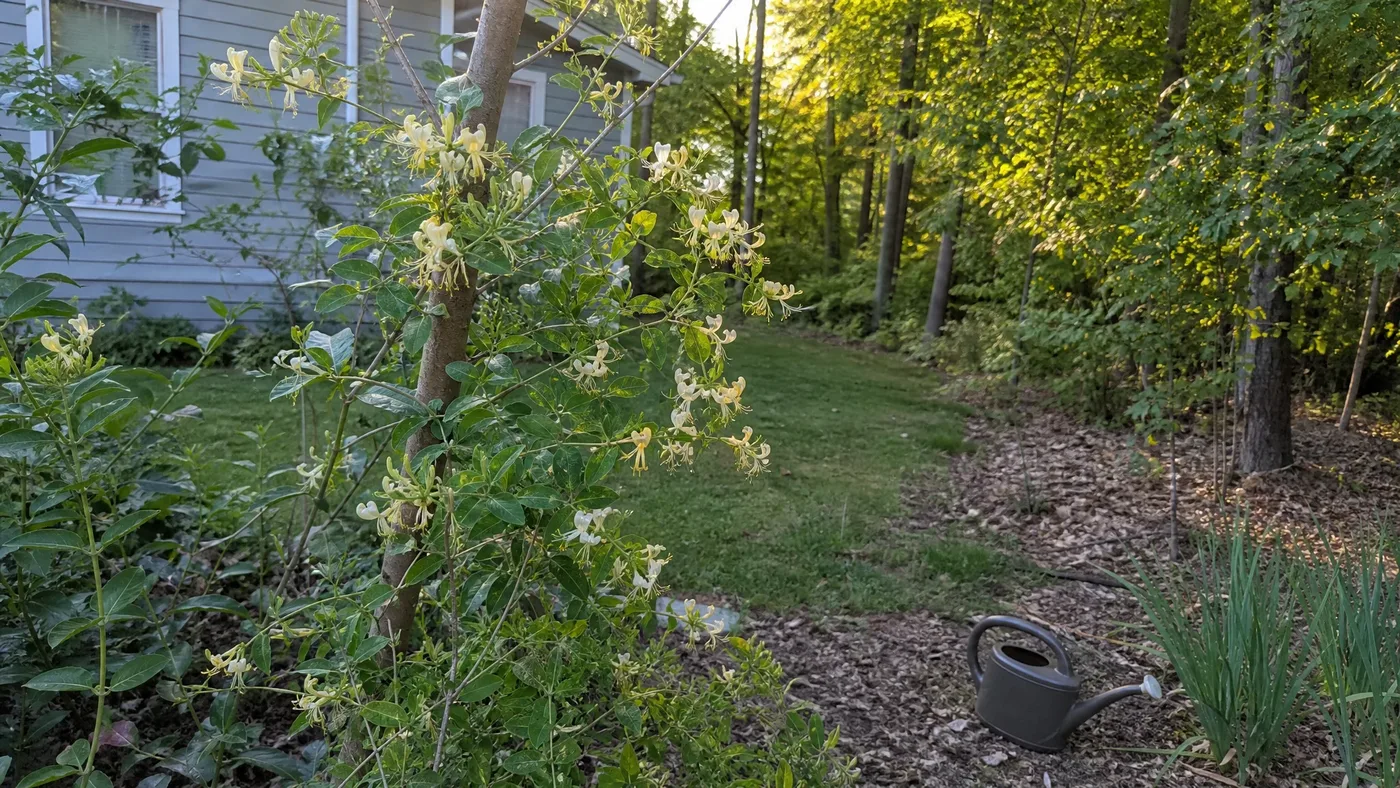
Can You Train Scentsation Honeysuckle Up a Tree?
The first June someone tried a honeysuckle on the old crabapple behind the farmhouse, the whole family stood back with their arms folded, because everybody knew a story about a vine that went up a tree and never let it breathe again. By August the branch tips were still in leaf and the porch smelled like warm honey.
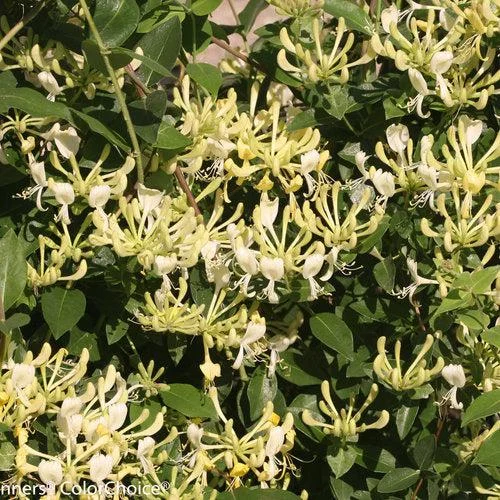
We saw the same thing this season in our rows, where a Scentsation wound up a stake and into the lower limbs of a fruit tree without crowding it. A living tree can be the best support you will ever have, free and already standing, and it can also be a mistake if the vine is greedy or the bark is tender.
Read on for four yard situations, from a narrow side bed to a hot deck, then the care an old orchard tree needs and the point where a tree is simply too big.
What a Living Tree Offers Scentsation Honeysuckle
A small to medium tree gives a twining vine what no fence quite can: branches at every angle, a crown that lifts the flowers to where the scent drifts across the yard, and dappled light for a plant that takes full sun or partial shade. Every slender twig is something the stems can wrap. In return you get creamy white to yellow flowers from summer into autumn, long after most trees have finished.
The usual warning, never let any honeysuckle touch a tree, was written about Japanese honeysuckle and is right about it. That vine can put on about 30 feet of stem in a year, shades its host and eventually pulls the dead tree down. Scentsation is native to Europe and, as one extension horticulturist puts it, does not appear on any invasive species list.
Scentsation Beside Japanese Honeysuckle
On height alone the two vines are closer than you might expect. The difference is in width and in habit, and the table below sets out the figures. Our side-by-side look at the two vines goes further.
| Trait | Scentsation | Japanese honeysuckle |
|---|---|---|
| Height | About 13–26 feet | 16–29 feet |
| Spread | About 1.6–3.3 feet | 3–6 feet |
| Stem growth | Restrained twining | About 30 feet a year |
| Habit on a host | Climbs without smothering | Overtops and smothers |
A Narrow Side Bed and a Slender Crabapple
Picture the bed along the side of the house, too narrow for a trellis and shaded by the eave, with one slim crabapple standing in it. This is the easiest case. Scentsation's spread is only about 1.6 to 3.3 feet, so it stays inside the width a slender tree already occupies, and it climbs instead of sprawling across the strip.
There is a seasonal bonus as well. The crabapple has its spring blossom, and the vine flowers from summer to autumn, so the same few feet of soil put on two shows, one after the other.
Where to Set the Plant
Plant a short way out from the trunk on the side with the most light, not hard against the bark. Crabapple roots run close to the surface, so dig by hand and work around any thick root you meet. Our guide on how to plant Scentsation Honeysuckle covers hole and depth.
Tree roots drink hard in a narrow bed. Scentsation likes moist but well-drained ground and copes with clay, loam or sand, so the soil matters less than the water. Soak the strip in dry spells instead of sprinkling it.
Giving It a Path Into the Branches
A trunk is too thick for the stems to wrap, so lean a cane from the plant's crown to the lowest sturdy limb at a slant. Tie the first shoots to the cane, not the tree. Once the stems reach the branch they carry on by themselves.
In a narrow bed the tree supplies the height and the vine supplies the summer.
The Windy Corner Lot and Scentsation Honeysuckle's Grip
A corner lot catches wind from two directions, and the common fear is that a vine will be torn off the tree in the first gale. The grip here is a twist, not a hold. Scentsation climbs by twining, so each growing tip circles whatever slender support it finds and tightens as the stem thickens.
How the Stems Hold On
Thickness decides it. Forest Service researchers report that even rampant Japanese honeysuckle cannot climb tree trunks wider than 4 inches without help from other vines. Scentsation, the less rampant of the two, should not be expected to do better. It wants thin twigs, fine lower branches and canes, so on a windy lot choose a tree with plenty of them and treat the trunk as something the vine passes by.
Getting It Through the First Gales
Customers usually ask us whether a storm will rip the vine loose. In our rows, the stems that came free were always young ones, before a full season of wrapping had thickened them. Tie new shoots loosely with soft ties until they have circled a twig once or twice, then leave them alone.
Plant on the sheltered side, where the trunk breaks the wind, and let the stems work around into the open crown. Wind also dries a corner lot fast, so mulch the root zone and water through dry spells.
A vine that has twined twice around a twig is held better by that twig than by any tie.
A Pot on a Hot Deck Beside a Dwarf Tree
A deck bakes. Boards and railings throw heat back at a pot all afternoon, and a container sitting in that all summer dries faster than you expect. The cultivar takes full sun or partial shade, so heat is no reason to skip it, but the roots should not take the deck's worst afternoon. Set the pot where the dwarf tree's foliage shades its side and the vine's top can still reach the light.
Scent is the reason to do this at all. Scentsation is exceptionally fragrant, and on a deck the flowers sit at nose height on warm evenings from summer into autumn. A pot puts the perfume exactly where you sit.
Sizing the Pot to the Tree
A pot holds the vine back, which helps beside a small tree, but it also makes the plant depend on you for water. Our guide to growing Scentsation Honeysuckle in pots covers sizes. Pick a heavy pot, because a tall vine on a cane catches wind like a sail.
Keeping the Vine Smaller Than the Tree
A dwarf tree has little room, and the cultivar's listed ultimate height of about 13 to 26 feet is more than most dwarf trees can carry. In a pot you are the limit. Train the stems up one side of the tree only, cut back any shoot heading over the top, and keep the lower branches clear so air moves through the foliage.
On the deck, the pot limits the roots and your shears limit the top.
The Old Orchard Tree With Tender Bark
Old fruit trees have thin, cracked and sometimes loose bark that is easy to hurt. The vine is not the threat, since slender twining stems leave only faint marks. The damage comes from what we do to help it: wire, nails, staples and ties left on for years until they cut in as the limb thickens. Everything here is about keeping hardware off the bark.
Soft Ties and Where to Put Them
What we tell customers is to train an old tree in this order:
- Plant at the outer edge of the tree's spread, away from the big roots and the trunk.
- Run a cane or a length of soft cord beside the trunk up to the first sturdy limb, and tie it to a stake, never to the tree.
- Guide the young shoots to the cane by hand and tie loosely in a figure eight with cloth strips or stretchy plant tape.
- Cut every tie once the stems have twined onto the branch.
- Look over the vine each year and loosen or remove anything that feels snug.
Choosing the Limbs
Pick one or two strong limbs on the sunny side as the vine's route and leave the rest clear. Never train onto a dead or hollow limb, which may fail under the weight. An orchard tree needs light in its crown to ripen fruit, so a vine allowed to fill every branch is competing with the harvest.
Trim stems that wander onto fruiting wood, and see our guide on when and how to prune Scentsation Honeysuckle for timing.
Where Scentsation Honeysuckle Meets a Tree Too Big
Here the vine's restraint stops being enough. The species is listed at 10 to 20 feet, the cultivar at about 13 to 26, and one university plant database notes the vine reaches 10 to 20 feet depending on structure. Our guide on how big Scentsation Honeysuckle gets has the details.
Trees That Are Too Large
On a tall oak or a mature maple the vine reaches only the lowest part of the crown. That does no harm, but it is a vine at the foot of a tree instead of in it, and a trunk far over 4 inches across gives it nothing to wrap. A dense conifer or heavy shade tree adds a light problem, since the vine wants full sun to partial shade and will flower little in deep gloom.
Trees That Are Too Small
At the other end, a sapling or a thin-stemmed ornamental cannot carry a vine. The Forest Service describes Japanese honeysuckle overtopping small trees and pulling dead hosts down. Scentsation is far lighter, but a young tree with a few twigs is still outmatched. Wait until it has sturdy limbs.
This table sums up how we sort the trees.
| Tree | Fit | What to do |
|---|---|---|
| Slim crabapple | Good | Cane to the lowest limb |
| Old orchard tree | Good with care | Soft ties, one or two limbs |
| Dwarf tree beside a pot | Fair | One side only, trim often |
| Tall shade tree | Poor | Use a trellis or post nearby |
| Newly planted sapling | Poor | Wait for sturdy limbs |
What These Yards Say About Scentsation Honeysuckle and Trees
The answer is yes, with conditions. Choose a small to medium tree with sound limbs and thin branches for the stems to wrap, give the vine a cane to reach them, keep hardware off the bark, and cut back whatever strays beyond the tree's own size. Scentsation's restrained twining makes all of that possible, where Japanese honeysuckle would simply win.
The tree behind the farmhouse is still there. In January it stands bare and unharmed, and the only sign a vine ever climbed it is a few faint twining marks on the thin twigs, where last summer's stems once held on.
Scentsation Honeysuckle
Nursery-grown Scentsation Honeysuckle in sizes from 2 GALLON, shipped to your door.
From $94.30
Shop Now →We grow Scentsation on our farms in moist, well-drained soil in full sun to part shade, the same conditions we suggest for it beside a tree. Every Scentsation we ship is potted and packed by us so it arrives ready to plant, and every plant we ship comes from our own rows. Browse our vines whenever your tree is ready for a climbing partner.