Scentsation Honeysuckle Is a Vine, Not a Shrub Honeysuckle
You bought a honeysuckle, planted it, and now it is standing up on its own with no trellis anywhere near it. So which one do you have? If it is a stiff, multi-stemmed bush, you almost certainly have one of the shrub honeysuckles. If it is reaching for something to wrap around, you have a vine, and Scentsation is the vine we mean.
The name covers both, and the gap between them matters. One gives you a fragrant climber that rewards a good support. The other group includes shrubs that have become serious problems in woodlands, and planting one by mistake costs you the wrong shape and possibly a plant you never wanted.
In this article, we'll go through how the two growth habits differ, how to tell them apart on sight, why the shrubs invade, and how to buy and site Scentsation correctly.
Scentsation Honeysuckle Twines While Shrub Honeysuckles Stand Upright
Honeysuckle is a genus, Lonicera, and that genus holds two very different builds. Scentsation, Lonicera periclymenum 'Scentsation', is a deciduous climber with oval leaves and long, flexible stems. The shrub honeysuckles we get asked about most, Lonicera maackii, morrowii and tatarica, grow as freestanding bushes. Same genus, same common name, opposite habit.
How a Twining Vine Grows
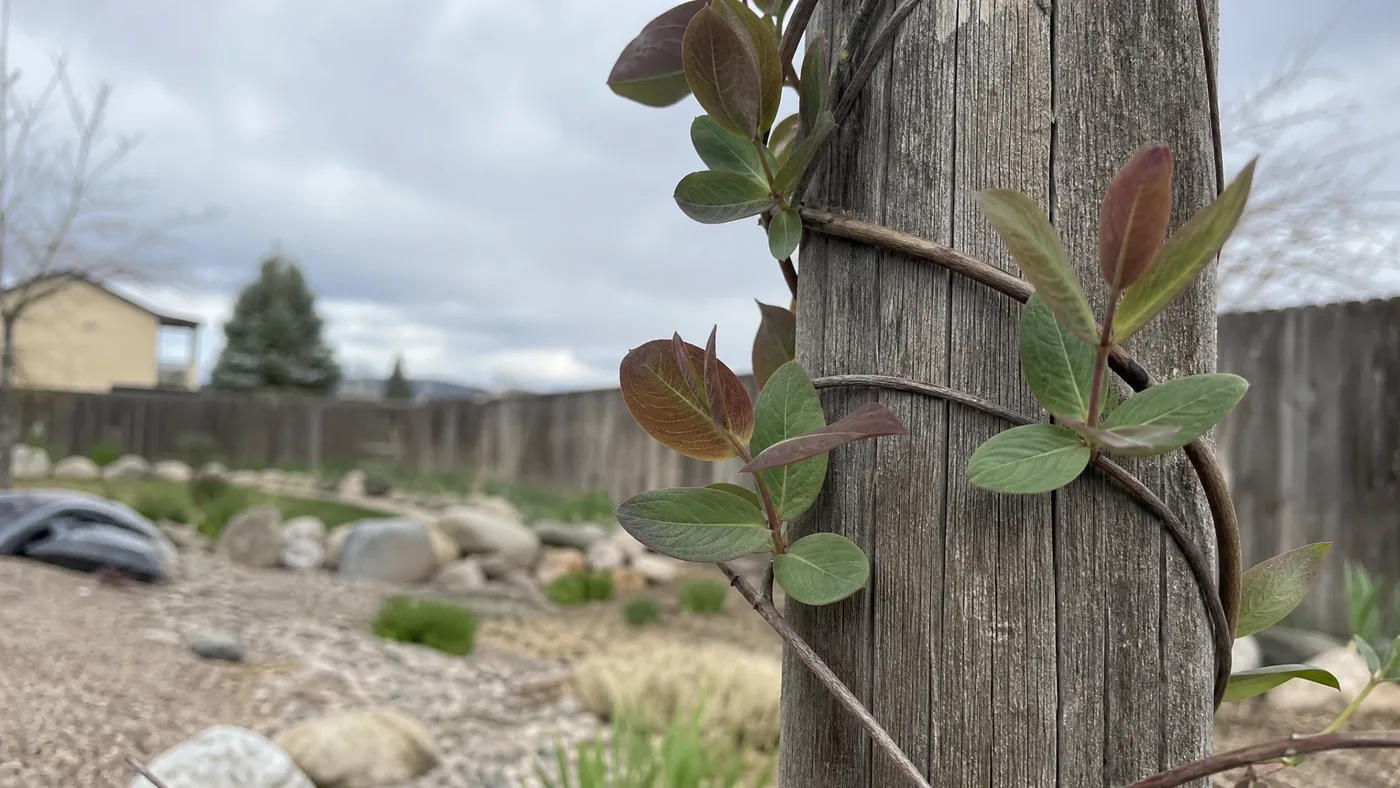
Scentsation climbs by winding its young stems around a support. Without one, it sprawls. Penn State Extension describes the species as a large vine, topping out at 10 to 20 feet tall and 3 to 6 feet wide.
The cultivar runs taller and slimmer than the species, at about 13 to 26 feet tall and roughly 1.6 to 3.3 feet wide. Our guide on how big Scentsation gets and how fast follows that growth year by year.
How a Shrub Grows
Nebraska extension describes Amur honeysuckle, the maackii of the three, as an erect, multi-stemmed, deciduous shrub that can grow to 15 to 20 feet. It builds its own woody frame from the base and holds itself up.
There is no twining and no need for a trellis. Morrowii and tatarica share that upright, bushy habit. Shape is the first thing to look at, and it settles the question faster than any leaf or flower.
Reading Stems, Leaves, and Berries in the Nursery
Plants at the bench are often in pots without a single flower, so you need checks that work on a green plant in any month. Run them in this order. The first one usually settles it, and leaf shape alone rarely does.
- If the plant stands up by itself with several stems rising from the base, it is a shrub honeysuckle. Put it back, because Scentsation never holds a freestanding shape.
- If the shoots are long and bendy and their tips are curling around the cane, the wire or the next shoot, you are looking at a climber.
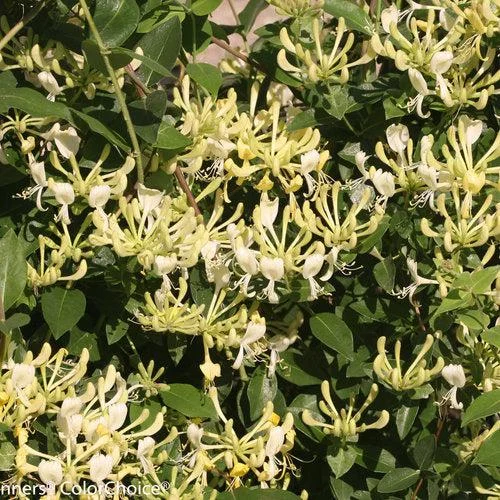
- If the plant is in flower, check the color. Scentsation opens creamy white to yellow in narrow tubes, and the scent is strong. Mississippi State Extension notes the flowers look very similar to Japanese honeysuckle, so flowers alone do not rule out the invasive vine.
- If you see berries, treat them as ornamental. Scentsation's fruit is not to be eaten.
- If the tag has no botanical name, ask before you buy. The next section explains why.
Timing gives one more clue outdoors. Amur honeysuckle is one of the first plants to leaf out in spring, so a bush in full leaf while the woods around it are still bare is a bad sign. That is a field clue for wild plants, not a test for a pot at the bench.
One of the most common questions we get is whether a honeysuckle that arrives without flowers can be trusted as the climber. It can, if the stems are long and flexible and the tag names Lonicera periclymenum.
Why Bush Honeysuckles Invade and Scentsation Honeysuckle Behaves
Invasive plants win by getting a head start, forming dense stands and traveling on wildlife. Amur honeysuckle does all three, and the extension record on it is blunt. The record on Scentsation reads very differently.
How the Shrubs Take Over
Amur honeysuckle is a listed invasive in the central and eastern USA. It grows quickly to a tall shrub of about 15 feet, and it is not recommended for any garden or landscape because it is aggressive and weedy.
Nebraska extension explains the mechanism. The shrub forms large stands that keep native shrubs and understory plants from growing, it leafs out earlier than most plants, and its seed is spread by wildlife. Each trait feeds the others.
Why Scentsation Stays Put
Scentsation is a European selection. Mississippi State Extension says this selection is native to Europe but does not appear on any invasive species list. Penn State Extension says the species has naturalized in Pennsylvania but is not considered invasive.
Tame does not mean timid, though. Scentsation is a vigorous climber that will fill its trellis and ask for pruning. Invasive lists differ by state, so check with your local extension service before you plant anything in the genus.
If your worry is the invasive vine rather than the shrubs, our comparison of Scentsation and Japanese honeysuckle covers that case. For the shrubs, the rule is simple: they are the ones with the record, and the vine is the one with the clean sheet.
Buying by Common Name Fails, Buying by Botanical Name Works
Shop for "honeysuckle" and you get whatever the seller means by it. Signs, listings and plant tables lump bushes and vines together, and a shopper who types "honeysuckle bush" or "honeysuckle vine" can easily end up with the other one. A common name is shared across plants that have little in common, and that is the whole problem.
The botanical name does not have that flaw. Ours is Lonicera periclymenum 'Scentsation', a genus, a species and a quoted cultivar name. Periclymenum marks the European climber, native to Europe and North Africa. Maackii, morrowii and tatarica mark the upright shrubs. The cultivar name tells you which selection you hold, a creamy white to yellow bloomer that is highly scented.
Customers usually ask us whether "woodbine" is a different plant. It is not. Woodbine honeysuckle is a common name for Lonicera periclymenum, so that tag is fine if the botanical name sits beside it.
A Four-Step Tag Check
Use this routine at any bench or on any listing, in this order.
- Find the genus and species. Lonicera periclymenum is the one you want.
- Find the cultivar name in single quotes. For this plant it is 'Scentsation'.
- Look for a habit line. Climber, twiner or vine fits. Shrub or bush does not.
- If any step is missing, ask the seller, and walk away if they cannot answer.
Every plant we send out carries its full botanical name, and our buying guide to container sizes shows what to expect once it arrives.
Give Scentsation Honeysuckle a Trellis, Not a Hedge Row
Because "honeysuckle" suggests a bush, many people plant it like one, as a row of plants in open ground with nothing to climb. That is the most common way we see this vine go wrong, and it is easy to avoid once you know what the plant wants.
Why a Hedge Row Fails
Without upright support, the long stems fall back on themselves and knot into a mound. The flowers end up at ground level or buried in the tangle, where you cannot enjoy the scent at nose height. The crowded, airless base also suits the powdery mildew and leaf spot that honeysuckles are prone to.
What the Vine Wants Instead
Give it vertical structure. The species reaches 10 to 20 feet in height, and the cultivar grows taller, so size the support for the tall end of that range, not the short end. A trellis, an arbor or a run of wires all work.
Twining stems wrap best around slim supports. Wire, rope, narrow slats and thin lattice give them something to grip, while a wide board or a fat post gives them nothing. Tie the first few shoots loosely to the support, and the vine takes over from there.
The cultivar's spread is only about 1.6 to 3.3 feet, so the support can be narrow and tall rather than wide. Our landscape ideas for Scentsation vines and fences show several layouts that suit that shape.
Open Fence Line or Tight Corner, Where Each Fits
Two sites come up again and again when people ask us where to put this plant. An open fence line has room to spare, while a tight corner has almost none. The table sets Scentsation against a shrub honeysuckle at each, using the Amur figures from the extension sources above.
| Site | Scentsation Honeysuckle | Shrub honeysuckle (Amur) |
|---|---|---|
| Open fence line | Fits well. Wire or rails give the twining stems plenty to grip, and the scent drifts along the fence. | Reaches about 15 feet and is not recommended for any landscape. |
| Tight corner | Fits if you give it height, since the cultivar's spread is only about 1.6 to 3.3 feet. | Needs far more room than a corner offers. |
| Paved or potted spot | Works with an obelisk or a narrow trellis in a container. | Not a sensible choice for confined spaces. |
On an open fence, the vine can sit in full sun or partial shade, since the cultivar tolerates both, and moist but well-drained soil suits it. Leave the plant some air around its base so the foliage dries quickly after rain.
In a corner, the narrow spread is the advantage. Run the support up the wall, leave a small gap behind it for airflow, and let the vine climb. If the corner is paved, our guide to growing Scentsation in pots and containers covers the setup.
Our choice is plain. Scentsation goes on the open fence if you want the most scent along a path, and in the corner if space is tight. If you want a freestanding shrub, choose one that is not on your state's invasive list, and leave the three bush honeysuckles at the nursery.
Be Sure of Your Scentsation Honeysuckle Before You Plant
Scentsation is a twining climber, and the invasive honeysuckles that share its name are upright shrubs. Habit tells you which you have, the botanical name Lonicera periclymenum 'Scentsation' confirms it, and a slim, tall support gives the vine what it needs. The shrubs spread through woodlands, while this selection is native to Europe and absent from invasive lists.
Before you buy, check three things: the stems, the tag and the flowers if there are any. A rule of thumb to carry to the bench: if the plant stands up without a stake or the tag has no botanical name, leave it where it is.
Scentsation Honeysuckle
Nursery-grown Scentsation Honeysuckle in sizes from 2 GALLON, shipped to your door.
From $94.30
Shop Now →Up our tall supports, Scentsation climbs in moist but well-drained soil with a good share of sun and a bit of shade, which is how we keep its true twining habit. Growing and selling top-quality plants from our own farms is what we do, and we would be glad for you to begin your vine with one of ours.