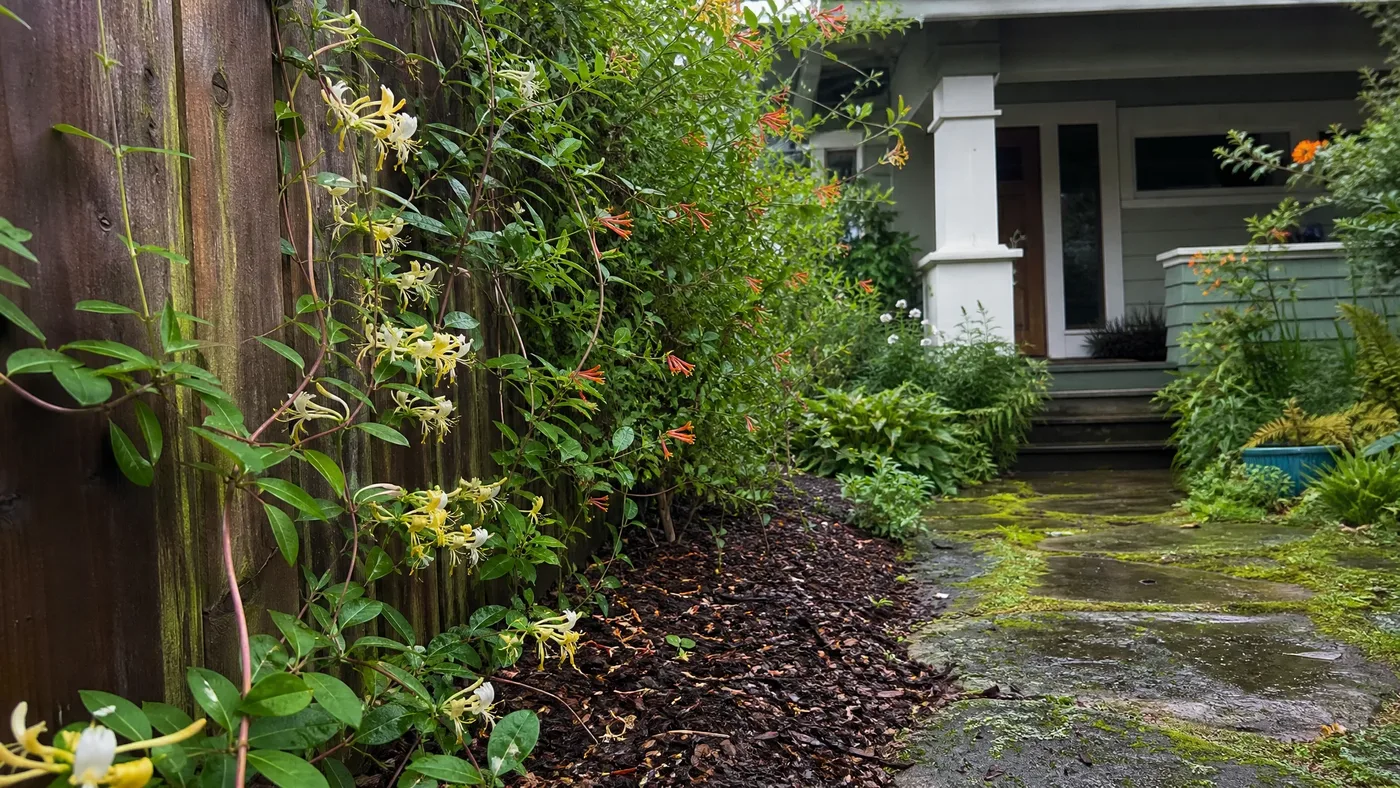
Scentsation Honeysuckle vs Coral Honeysuckle: Scent and Range
Every July we hear the same two complaints. One customer picked a honeysuckle off a nursery tag, planted it by the patio, and now stands out there at dusk smelling nothing. Another planted the fragrant one and watches the hummingbirds work the neighbor's feeder instead. Both bought a good vine. Neither knew what the other vine would have given them.
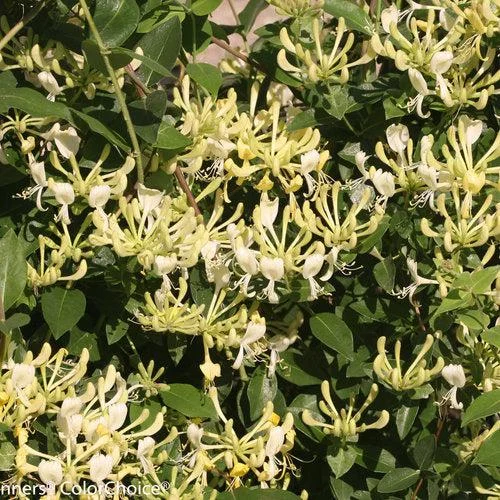
This guide sets Scentsation Honeysuckle (Lonicera periclymenum 'Scentsation'), the European, heavily perfumed vine, against Coral Honeysuckle (Lonicera sempervirens), the eastern US native that birds love and noses ignore. Below, you'll find out all about how to choose between them, including scent against hummingbird traffic, native status, hardiness zones, what each vine looks like after bloom, and where each belongs.
Settle Fragrance Against Hummingbirds Before Anything Else
On a tag, these two look like cousins. Both carry tubular flowers, both climb 10 feet or more, and both say honeysuckle in big letters. In the yard they behave nothing alike. Scentsation is the nose vine. UC Master Gardeners call its creamy white and yellow flowers highly scented as its name suggests, and that perfume is the reason most people plant it beside a seat or a door.
Coral goes the other way. Its flowers are not fragrant, but the trumpet-shaped blooms attract hummingbirds, butterflies and bees, and hummingbirds are the actual pollinators of the species. The shape is built for a bill, not for a human nose. That is the plant's design, not a defect, which is why we never describe Coral as a weaker Scentsation. It is a different tool.
Picture the spot. If it sits beside a patio table, a bedroom window or a path you walk at dusk, scent does the work and you will notice it every night. If it faces a kitchen window or a fence you watch from a chair with coffee, hummingbird traffic does the work. A wall you pass twice a week deserves neither argument, so pick whichever vine you would rather look at.
One of the most common questions we get is whether Coral smells like the honeysuckle of childhood. It does not, and for some people that settles everything on the spot. Write your priority on a sticky note, scent or hummingbirds, and keep it where you can see it. Every section below is a tie-breaker for that one word, and the first answer you wrote is usually the right one.
Native Status and Scentsation Honeysuckle's European Roots
Scentsation is a cultivar of woodbine, Lonicera periclymenum, and the species grows wild across the UK and Europe, north to Scandinavia and south to North Africa and Greece. Coral is the opposite case, native to the eastern United States. If your garden plan reads as local ecology first, that single difference may decide the question before scent or hummingbirds get a vote.
Origin does not make a vine a problem, though. Mississippi State's extension team says this selection is native to Europe but does not appear on any invasive species list. The honeysuckle with the bad reputation here is Japanese honeysuckle, and Coral is promoted in Florida as a Florida-Friendly alternative to it. Scentsation sits on the well-behaved side of that line.
The usual advice is to plant natives or not bother, and we would tighten that. Native status matters most when you want to feed specific local wildlife, and Coral does that well. It does not turn a European vine that stays off the invasive lists into a mistake. A native left unwatched on a wall you never use helps no one, and a fragrant vine you visit every evening helps you.
Our stance: native status is not a deal-breaker for Scentsation unless you are building a native-only planting or your local rules say so. If either is true, choose Coral and move on without guilt. If neither is true, let your sticky note decide. We go further in our guide on whether Scentsation is native to the United States.
Checking Your Zone Before Falling for Scentsation Honeysuckle
Zones settle more of these decisions than people expect. NC State rates Coral Honeysuckle for USDA zones 4a through 9b. For Scentsation, the number we can stand behind is the species rating, 5a through 9b. We found no separate zone rating for the cultivar itself, so treat that as the species range and confirm it with your local extension service before you spend a season training a vine.
Here is how the two compare on range.
| Vine | Zones | What it means for you |
|---|---|---|
| Coral Honeysuckle | 4a–9b | Reaches colder yards that Scentsation may not |
| Scentsation (species rating) | 5a–9b | Confirm the cultivar locally |
| Overlap | 5–9 | Zone will not decide it, so use your priority |
If You Garden in Zone 4
Coral has the edge here, a full zone colder on paper. If you garden in zone 4 and want scent, ask your extension office whether anyone near you grows Scentsation through winter before you buy. A vine that is marginal in your winters is a gamble on exactly the wall you care about most, and we would not take that bet for a feature as seasonal as perfume.
If You Garden in Zone 9
At the warm end both vines are rated through 9b, so range is not the difference. Winter habit is. Coral is evergreen in the warm winter climates of the Deep South, while Scentsation is deciduous and drops its leaves. If you want a green wall in January, that favors Coral. Our guide to Scentsation hardiness zones covers the limits in more detail.
The Keep or Drop Call
Keep Scentsation on your list if you garden in zones 5 through 9, and drop it if you are in zone 4 unless a local grower vouches for it. Coral stays on the list everywhere in its range. For most readers the zone question is a formality, which sends the decision straight back to scent or birds.
Bloom Season and What Each Vine Leaves Behind
The flowers are only part of the year, so look at each vine on both sides of bloom. Coral flowers in mid-spring, so its show comes early and fast. Scentsation runs later, summer into autumn for the cultivar, though timing shifts with your climate. Do not judge it by wild woodbine, which blooms in spring and only sporadically through summer.
After Coral's Spring Flush
Once the spring flowers pass, Coral is a green vine that does little to advertise itself, and the hummingbirds you planted it for have fewer reasons to stop. In the Deep South it stays evergreen, which carries the wall through winter. Farther north, do not count on that, and plan for a plainer vine in the cold months.
After Scentsation's Long Season
Scentsation flowers longer, so its quiet stretch is winter rather than summer, when the deciduous leaves drop and the stems show. It also asks more of you. Powdery mildew and fungal leaf spot are the diseases to watch, and honeysuckle aphids and thrips are the usual pests. Our pruning guide covers timing so you keep next summer's flowers. The ornamental fruit is not to be eaten.
On size, the cultivar is reported at about 13 to 26 feet tall but only about 1.6 to 3.3 feet wide, narrower than the species' 3 to 6 feet. That slim habit suits a tall, narrow trellis better than a broad one.
Choosing What You Will Tolerate
The trade is plain. Scentsation asks you to accept a bare winter trellis and some mildew watching in return for months of perfume. Coral asks you to accept a quieter summer in return for an early burst of birds. If you cannot stand a leafless trellis, Coral in a mild climate is easier. Otherwise, take the bare months and keep the longer bloom.
Coral Honeysuckle Without Scent: Can You Live With It?
Be clear about what you are giving up. Coral's blooms are non-fragrant, full stop, which surprises people who assume the word honeysuckle comes with perfume. Scentsation sits at the other end of the scale, and the evening air near a mature vine is the whole point of it. If you lean toward Coral, you are trading the dusk experience for a daytime one, and you should do that on purpose.
What you get back is traffic. Coral is a twining vine that reaches 10 to 20 feet, and its flowers pull in hummingbirds, butterflies and bees. In our rows, Coral vines get their visitors by day, and the evening air around them is just evening air. If you want to know how the fragrant vine does with visitors, our guide to hummingbirds and pollinators covers it.
Can you live with the missing scent? We think most people can if they plant fragrance somewhere else. A pot of something perfumed by the door, or a Scentsation on a different wall next year, fills the gap. The people who struggle are the ones who chose Coral for the native label and then sit outside at dusk wishing for the smell they imagined.
Our verdict: the birds make up for the missing scent only if you will actually watch them. If your sticky note says hummingbirds, Coral wins and you will stop missing the perfume by midsummer. If it says scent, no amount of wings replaces it, and you should plant Scentsation.
Scentsation Honeysuckle for Evenings, Coral for Birds
Here is the final matching, spot by spot. Both vines run big, with Coral reaching 10 to 20 feet and Scentsation reported at about 13 to 26 feet, so either needs a sturdy trellis, arbor or fence rather than a decorative panel. Scentsation takes full sun or partial shade and likes moist, well-drained soil, whether clay, loam, sand or chalk, which makes it easy to place.
Use these pairings as a starting point:
- A patio, porch rail or bedroom window you use at dusk goes to Scentsation, because that is where the perfume reaches you every evening.
- A fence line you watch from the kitchen, or a bed built around a feeder, goes to Coral, where the hummingbirds are the audience.
- A native-only planting, or a garden in zone 4, goes to Coral without a second thought.
- A sunny or partly shaded arbor in zones 5 through 9 where people gather after dark goes to Scentsation.
Planting both is a legitimate answer, and it is the one we would pick with the room. Give each its own support so the two never tangle, and keep the scent side and the bird side of the yard distinct. Put Scentsation where you sit after dinner and Coral where you watch from a window. Our guide to why Scentsation smells so good goes deeper on the fragrance side.
If we could plant only one on a typical patio, we would plant Scentsation, because scent is the one thing Coral cannot offer at all. If you named hummingbirds on your sticky note, or you garden in zone 4, we would pick Coral.
Pick Your Priority, Then Plant Scentsation Honeysuckle or Coral
Scentsation gives you perfume on summer evenings, a slim climbing habit and a long bloom, in exchange for a European origin and bare winter stems. Coral gives you hummingbirds, native status and a wider zone range, in exchange for any scent at all. Buy the one that fits your priority, mark the other for next year's wall, and go plant.
Scentsation Honeysuckle
Nursery-grown Scentsation Honeysuckle in sizes from 2 GALLON, shipped to your door.
From $94.30
Shop Now →Scentsation thrives in our care because we plant it where the soil stays moist yet drains freely, and where it gets sun for most of the day plus a touch of shade. Our own growers raise and pack every top-quality plant we offer. If evening perfume is the priority you chose in this guide, pick out a Scentsation Honeysuckle for your garden when you are ready.